Thursday, December 23, 2010

Walks Like a Duck

Waddle
I always thought a waddle was what a duck did, but it turns out it's a 25 foot long mesh bag filled with rice straw that helps with erosion control.

Cindy and I struggled to get it out of the car and into the backyard when we bought it a couple of weeks ago.  We were covered with rice straw and dust by the time we got it into place on the edge of the canyon.   Greg and Brian heaved it around like it was nothing, but even when it's dry it weighs a lot, and now that it's wet, it probably weighs a lot more.  We're hoping it will help slow down the erosion of the edge of the canyon.

One thing is for sure:  it's not going anywhere as long as it's wet.

Oh, yes, and GO DUCKS!!!  BEAT AUBURN!!!  QUACK QUACK QUACK!

Wednesday, December 22, 2010

Chinaberry Tree

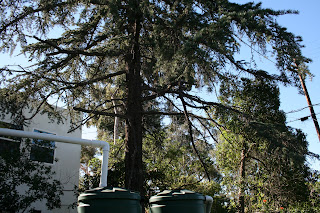
Chinaberry Tree in December
It's still raining here.  The ground is so sodden now that we are seriously concerned about erosion.  The Chinaberry tree is our bellwether--it clings to the edge of the canyon, and as long as it's there we know most of our yard is still there.  The canyon drops away so steeply that its roots are being steadily undermined, and some day it may go.  We get up and check to see if the tree's still there whenever we've had a lot of rain.

It's the tree in the background of this picture.  I deliberately shot it this way so we can have a marker, in the form of the white patio roof post, to check on whether the tree is still upright or if it's leaning more to the right and beginning to slide into the canyon.  The canyon drops away abruptly just to the right of the tree and just behind the boxwood hedge.

It's a great old tree.  It's clearly been around a long time.  A much larger branch evidently cracked off of the left hand side some years ago, but the tree keeps on thriving.  It's a survivor and we hope we can save it.

Chinaberry Tree in September

Tuesday, December 21, 2010

The Pineapple Express Comes to Town

The tropical weather formation known as the "Pineapple Express" has arrived and is inundating our back yard.  We thought this was going to be a "La Nina" year, which would be a low rainfall year, but it's acting like an "El Nino" year instead.  Yesterday the wind was blowing hard and blew down a lot of palm fronds on the streets and yards, but today it's just raining.  And raining.  And raining.  At least with the Pineapple Express, it's relatively warm wind and rain, unlike storms coming out of the Gulf of Alaska.

We've had so much rain the last couple of days that the planter around the garage is full of water and the area behind the garage is so sodden that you sink in a couple of inches if you step in certain areas back there.  Roy's guys showed up to trim the pine tree branches today in spite of the rain; they would not have been able to do it if the wind had been as strong as it was yesterday, but rain wasn't a problem for them.

Thursday, December 16, 2010

Bring Me A Shrubbery--Part Deux

Apparently we are not the only household to receive a love-note from the city about cutting back our vegetation.  Several of our neighbors have also received similar letters; some are doing something about it and some seem to be ignoring them.  Some just seem to be dazed and confused.

Our neighbor Meredith came down to borrow some balsamic vinegar last night and said she had been chopping away at the vegetation behind her house all day.  The guidelines on this are so vague we all feel as if we're trapped in a Monty Python sketch.  "Bring me a shrubbery!  No, not that shrubbery, the one a hundred feet from your house!"

Behind the Fence--Before...
Anyway, we've made great progress on it this week.  Greg Eubanks, our landscaper, is also a Master Gardener and has the knowledge and skill to make this a successful project, in spite of the fact that his truck burned up on Monday, incinerating most of his tools along with the truck.

Greg and his helper Brian tore into it all day yesterday, unearthing a rusty roll of chain link fencing, broken concrete, bricks and some ancient cast iron pipe, as well as an enormous pile of plant debris.  The brush was so thick before they started that the telephone pole at the back of the property was hardly visible.

The Same Area--After Clearing
Now the telephone pole and the ground are both visible.  However, now we have the added problem of potential erosion from the area on the left, which is higher and part of the slope down into the canyon of the right.

Part two of the project will be to create some terracing in the area on the left, probably with some railroad ties to create a break in the slope that we hope will slow down the erosion.


And, of course, we still have to get rid of the huge piles of plant material they pulled out of the area.
Part of the Debris

Wednesday, December 15, 2010

Hacking Away

Eugenia Hedge Before....
Yesterday we got to work on chopping back the overgrown remains of the Eugenia hedge to reduce the amount of fuel for wildfire on the north side of the back yard.

The Eugenia was so overgrown you couldn't even see the equally overgrown Oleander behind it.  The Oleander is right on the edge of the canyon.  It's nasty stuff; the Eugenia is a nuisance because it grows so exuberantly and requires constant vigilance to keep it in check, but at least it's not poisonous like the Oleander.  The Oleander flowers are beautiful, but this particular plant has black sooty mold, Oleander scale and the Fire blight that will eventually kill the plant.

... and After
So we hacked away at the shrubbery for a couple of hours and eventually subdued it.  We kept the little patch of catnip growing at the edge of the space, but now we're reluctant to give it to the cats because of all the toxic Oleander clippings we dragged through there.

The Eugenia looks much neater now, but we know it will be back.  Still, there is a real sense of satisfaction at putting is some effort like this and then seeing an immediate result.  That's one thing we like about the garden:  it's changing all the time, and there's something different almost every day.

Sunday, December 12, 2010

Bring Me A Shrubbery!!!!

We're really upset with the City of San Diego today.  Yesterday we received a "complaint" from the city fire inspector, telling us we need to get rid of the shrubbery behind our house to create a "defensible space" for fire protection.

Trumpet Creeper Jungle Behind the Fence
The reason we're so annoyed about this is that we really are true believers about the need to create this defensible space to protect property from the danger of wildfire.  We had a fire in our canyon three years ago and we have spent countless hours and thousands of dollars since then to lessen the danger and create a defensible space by cutting down a thirty foot high Eugenia hedge, by cutting back the jungle of Trumpet Creeper and Jade along the fence, and by having debris carted out of the canyon.  We had also planned to have more work done this next week on the area behind the fence because we want to plant a mini orchard back there at some point.

We know that area needs work, and we don't need the city to tell us to do it.  What makes it worse, however, is that next week that very same city also plans to repave our street--which really needs it--but that will make it impossible to get the truck in to haul away the debris that we cut out.  Arrrrgh.
Pine Tree With Dead Limbs
They also apparently want us to cut back the dead tree limbs that overhang our new rain harvesting system because they are close to the garage.  However, the pine tree with the dead limbs does not belong to us; it belongs to our next-door neighbor who refuses to recognize that the tree is dying and should be taken down completely.  So we'll have to pay more money to our arborist to take off the dead branches and possibly a couple that are still alive, and try not to "kill" the dying tree.


Red-Tailed Hawk Loves This Tree
Birds, especially large birds such as this hawk, love this tree because the top is dead and almost completely devoid of live branches, so they have an excellent view of potential prey in the canyon below.  The reason they have such a great view, of course, is that the entire top of the tree is dead.  It is no longer living; it has shuffled off this mortal coil; it has ceased to be; it...., oh, okay, back to the story.


Eugenia Hedge to Left of the House
One of the things we did several years ago was cut down the enormous Eugenia hedge on the north side of the house, on the left in this picture.  The hedge ran down along the property line to the edge of the canyon. It was about twenty feet tall at the front and about thirty feet high at the back end.  As far as fire danger went, that hedge would have provided a path and fuel for fire to race straight up from the canyon between the houses and could quite possibly have resulted in both houses burning.  So we cut the damn thing down, and that was the end of it.  Or so we thought.  Unfortunately, we didn't actually kill the roots, so it continues to grow back, and Eugenia grows very fast.

Eugenia Grows Back
The remnants of the hedge are part of the shrubbery we are going to take out this week.  This picture doesn't show it, but the ground slopes away very quickly under the shrubbery and it's difficult to maintain a footing so you don't end up sliding down the canyon on your butt.  Been there, done that, don't need to do it again.

One of the reasons we didn't kill the roots in the first place is that they help hold the soil in place and keep it from eroding into the canyon.

Steep Slope Into the Canyon
And that brings us to another problem with taking out shrubbery behind our house:  we're on the edge of the canyon, which drops off abruptly behind the boxwood hedge.  The slope is approximately sixty degrees and there is no footing whatever on it.  Even more worrisome is the clear evidence of erosion on the slope to the point where it is undermining our chain-link fence in the upper right hand corner of this photo.  We have to keep enough shrubbery to stop the erosion, or our fence and possibly our whole back yard may slide down into the canyon.  The city expects homeowners to maintain a defensible space of 100 feet from the house, but if you go that distance from our house, you're over the edge and down the slope.

Besides the boxwood hedge, another plant helping to slow down the erosion process is the native California Lemonadeberry tree (Rhus integrifolia)  growing up from the edge of the canyon.  These trees act as spark catchers during wildfire and may actually slow down the progress of a fire by stopping wind driven sparks from spreading the fire into new areas.  We plan to take off some of the branches that hang over the boxwood hedge below it, but we don't plan to cut the whole thing down because we need its protection against erosion.  One of the main features of the Lemonadeberry is its value in preventing erosion on slopes and cliffs.

Another item that annoys us is the fact that the city has not met its responsibility to maintain the canyon.  When Cindy and her sister Mary went down into the canyon last February, they found that the lower end of the canyon is completely impassable because of the dead branches, logs and other dead or overgrown plant material.  Even where they could get footing, the vegetation was too thick to proceed.  All that dead or overgrown plant material is just so much more tinder for wildfires.  We'll do our part, and we don't have a problem with that, but the city needs to meet its responsibilities, too.

Thursday, December 2, 2010

The Ants Are Marching...

Actually, the ants are always marching here in San Diego, just usually not in our kitchen.  We were out of the house most of the day yesterday and when we got back, Cindy was occupied with the new design for the back yard.  So when she finally did go into the kitchen, she was shocked to discover the wall beside the microwave swarming with ants.  Worse yet, the trail of ants led up the wall into the cupboard.

We spent a frantic hour pulling out boxes of cereal and crackers, tossing those that the ants had gotten into and putting the rest into resealable plastic bags.  We also kept mopping up the ants with a mixture of vinegar and water, and finally just vinegar when we ran out of the mixture.  The ant bodies were stacking up by the hundreds, but they just kept coming.  We finally put a couple of ant baits out, one in the cupboard and one taped to the wall--you have to put it in their path or they won't eat it, but if they do eat it, they will carry it back to the nest and it will eventually kill the rest of the ants in the nest.

Our "shop chic" faucet handle
But I'm afraid that definitely puts us into the redneck category, what with the ant bait taped to the wall above the microwave, right next to the sink with our vice grip faucet handle.  We called the vice grip handle "shop chic";  some of our friends think it's funny and practical, but others have called it "redneck" because of the rubber band on the vice grips.  It may look odd, but it works for us.

The ants we're fighting are the notorious Argentine ants that have invaded much of Southern California.  Unlike other ant species, or even the Argentine ants in their native Argentina, those in California are not genetically diverse and consequently do not fight one another, recognizing ants from other nests as fellow members of one giant colony.

The nests also may contain multiple queens, making them "egg laying machines" that contribute to the proliferation of the species.  It also means that if you kill one queen, the nest doesn't necessarily die.  And if the nest does die, more Argentine ants just move into the empty space in short order.  Sigh.